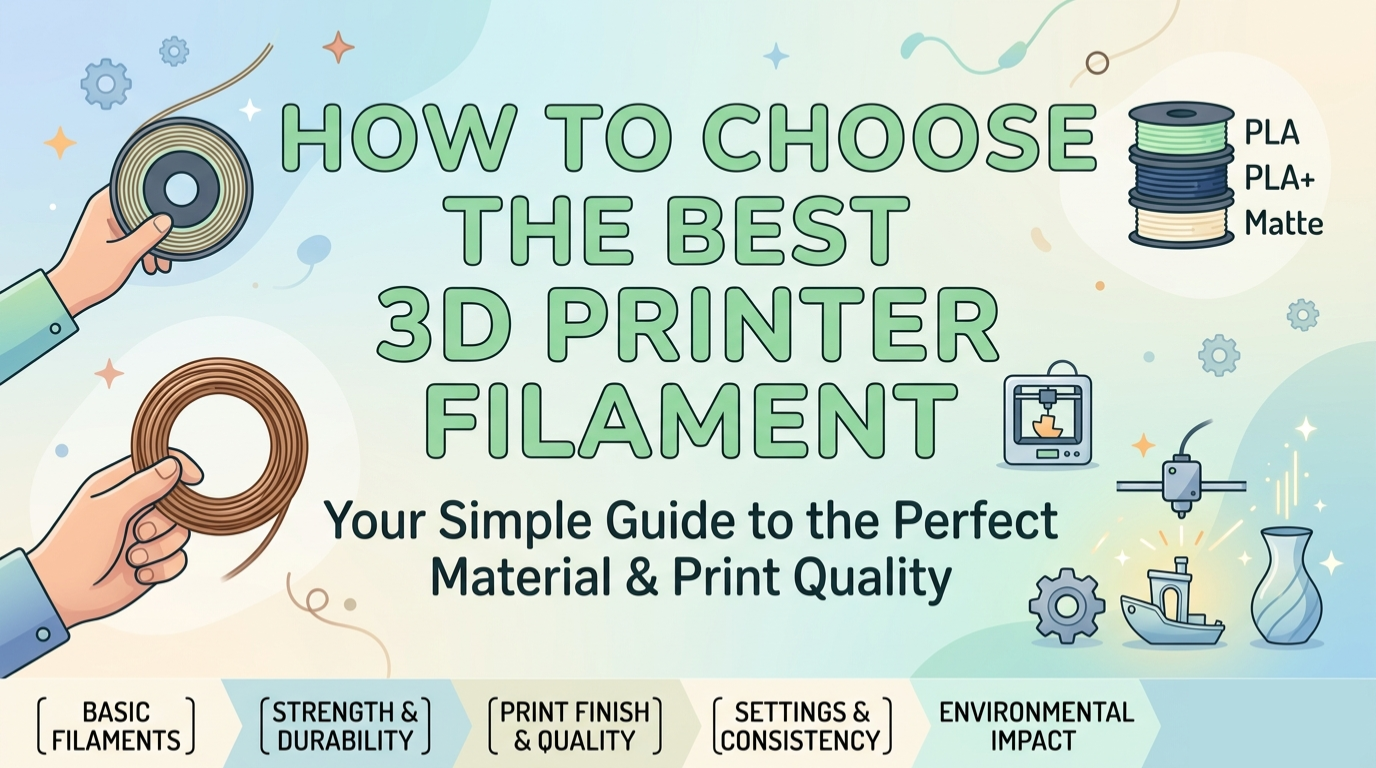
How to Choose the Best 3D Printer Filament
Beginning getting started 3D printing may be overwhelming, particularly when it comes to selecting the correct filament.
Recent Blogs
- Must-Have Fitness Gear For Smarter Health And Stronger Results
- How to Choose the Right Cleanser for Your Skin Type
- The Best Travel Credit Cards for 2025: Maximize Points, Perks, and Peace of Mind
- Easy Ways to Make Your Home Look Designer-Approved
- Tips for a Smooth Journey with Your Furry Friend
- How to Manage Oily Skin with the Right Products
- The Importance of Recovery Days in Your Fitness Routine
April 26 09
Beginning getting started 3D printing may be overwhelming, particularly when it comes to selecting the correct filament. The filament you select directly affects printing quality, strength and the overall quality. When printing models of a simple nature or intricate designs, choosing the correct filament is crucial.
Manufacturers such as SUNLU can make printing easier for both professionals and beginners with high-quality, reliable filaments that are simple to work with and produce reliable outputs. If you follow the correct guidelines, it is possible to select an appropriate filament to meet the needs of printing satisfaction.
Step 1: Understand The Basics Of 3D Printing Filament
Before examining specific options first, you must understand what filament is. When it comes to 3D printing filament, it's the substance which is melted, then layered in order to produce things. Different kinds of filament have various properties like the ability to stretch, strength and finishing.
For those who are new to printing, the PLA filaments are the ideal beginning base. They print easily and require less heat and are not as susceptible to problems like warping and cracking. The knowledge gained from these basic principles can help you make better selections as you research the more sophisticated options for materials.
Step 2: Begin By Using The Beginner-Friendly Filament
If you're just beginning to learn about 3D printing, ease of use and trustworthiness should be your primary goals. The standard PLA filament is among the simplest materials to print with and is perfect for those who are just starting out.
The PLA 3D Printer Filament 1KG is an outstanding illustration of an option that is user-friendly. It provides smooth printing, with no warping and minimal shrinkage. Its consistent performance is guaranteed even for new users. Its biodegradable and eco-friendly design can make it an environmentally responsible option for printing in everyday use.
The diameter tolerance is +-0.02 millimeters, this filament offers the highest level of precision that is vital for clean and exact prints. This filament type works effectively across a variety of printers. It is an ideal starting point for those who are just beginning to explore the possibilities of 3D printing.
Step 3: Consider Strength And Durability For Advanced Projects
Once you've earned knowledge, you might decide to print items which require greater robustness and durability. That's where advanced materials such as PLA+ are used.
PLA+ 2.0, also known as the PLA+ 2.0 upgraded PLA+(PLA Plus), 3D Printer Filament 1KG, has been specifically designed for those who require strong and durable prints. It has a strength of impact that is up to 2 times stronger than the standard PLA. It's perfect for practical parts as well as demanding designs.
Another advantage is the capability to print at high speed, which can reach as high as 300 mm/s. This lets you finish tasks more quickly without degrading the quality. In spite of its increased quality, it's still simple to print, which makes it an ideal step-up from standard PLA.
If your work involves mechanical components or products that have to endure strain, this kind of filament would be an excellent upgrade.
Step 4: Focus On Print Quality And Finish
In the eyes of many, the appearance and look of prints is as crucial as their durability. If you're making designs, prototypes, or other display items, the finish of the filament is very important.
The Matte PLA 3D Printer Filament 1KG is ideal for creating a smooth and professional look of an appearance. The matte finish diminishes the shine of your prints and conceals layers, which gives prints a sleek and polished look.
It also has excellent layer adhesion, as well as the highest fluidity. This helps to reduce stringing and enhances the overall quality of prints. By ensuring precise control of diameter and constant extrusion, it guarantees the highest quality results for intricate designs.
If you are looking for aesthetics, then switching to an elastomer filament will improve the overall appearance of your work.
The 5th step Is To Match The Filament To Your Printer's Settings
Selecting the correct filament involves understanding how it functions in conjunction with the printer settings. Every material comes with specific specifications for temperature and speed, which affect the efficiency.
In the case of the standard PLA, it generally prints between 200 and 210 degC. PLA+ could require more temperatures to achieve the best result. Matte PLA also has its individual recommended settings for getting the highest quality appearance.
Bed temperature is a different aspect. Some filaments may be used without a heated bed; keeping a temperature between 50 and 60 degrees helps to improve adhesion and minimise printing problems.
If you adjust your printer's settings to match the type of filament, you can achieve smoother prints while avoiding common problems.
Step 6: Look For Consistency And Quality Control
One of the major issues when it comes to 3D printing is the inconsistency. A poor quality filament can cause blockages, irregular extrusion and even failed printing. It is important to pick filament produced with the highest quality standards.
Premium filaments are carefully wound by vacuum packing and are free from contaminants. They are uniform in size and flow. This is vital for reliable printing.
When you purchase the right filament, you will spend less time resolving issues and spend more time making.
Step 7: Consider Environmental Impact
Since 3D printing is becoming more widely used, sustainability is becoming important. A lot of users are choosing eco-friendly products that minimise environmental impacts.
PLA-based filaments are typically biodegradable, and they are produced from renewable sources, which makes PLA a sustainable option in comparison to other types of materials.
If you choose a filament that is eco-friendly and materials, you will be able to enjoy your creativity while being aware of the environment.
Step 8: Choose A Brand You Can Trust
The right choice of filament doesn't only concern the substance, it's also about the name behind the material. Brands that are reliable ensure consistency in quality, higher performance and more efficient printing.
SUNLU is a household name for its top-quality filaments for novice and experienced users. The range of products includes simple printing, increased durability, and top-quality finishing, which makes it much easier to choose the right one for your requirements.
When you select a trusted company, you reduce the chance of printing problems and boost the overall quality of your printing.
Final Thoughts
Selecting the right 3D filament for your printer doesn't need to be a hassle. If you know your requirements and preferences, choosing the appropriate material and tweaking the settings, you will be able to print high-quality images with ease.
From simple PLA to tough PLA+ and attractive matte finish, every type of filament comes with its own benefits. It is important to choose the filament for your specific project needs.
With the reliable solutions from SUNLU, you can explore 3D printing options and create your own ideas using precision and imagination.
FAQs
Q1: What's the most suitable filament for newbies?
PLA filament is the most suitable option for those who are just starting out because of its simplicity of use and lack of printing difficulties.
Q2: What's the main difference between PLA and PLA+?
PLA+ is more durable, stronger, and more robust, and has a higher impact resistance than regular PLA.
Q3 Do I require a heating bed when printing with PLA filament?
Not often, but the heated bed in temperatures of 50 to 60 degC will improve adhesion and printing quality.
Comment:
Your email address will not be published. Required fields are marked *



You Might Also Like